When I was twenty, I wrote a paper comparing Satan from Paradise Lost and Hamlet from Hamlet. I wrote it while studying seventeenth-century poetry and prose at DeSales University, in a class taught by Professor. Ken Pfiefer. At the time, I approached the assignment as an intellectual exercise, an ambitious comparison between two complex and seemingly unrelated figures. Looking back now, however, the choice feels far less accidental. It reveals something about who I was becoming and the internal tensions I was already beginning to navigate.
Both characters exist in a state of heightened awareness. Satan defines himself through action, through rebellion, through will, through a refusal to submit. Hamlet turns inward, questioning, doubting, hesitating in search of truth. One moves with certainty, even toward destruction; the other delays in pursuit of certainty and is undone by the waiting. What I see now is that I was not simply analyzing their differences, I was drawn to the space between them.
That space was not theoretical. It was personal.

The class that anchored thought
At twenty, I stood at an inner threshold. There were parts of me that wanted to move boldly, to claim direction, to trust instinct, to create something of my own without waiting for full permission or understanding. And there were parts of me that needed alignment, to ensure that what I was building was meaningful, grounded, and in integrity. I did not yet have the language for this tension, so I explored it through literature, guided in part by the academic structure and inquiry fostered in that classroom.
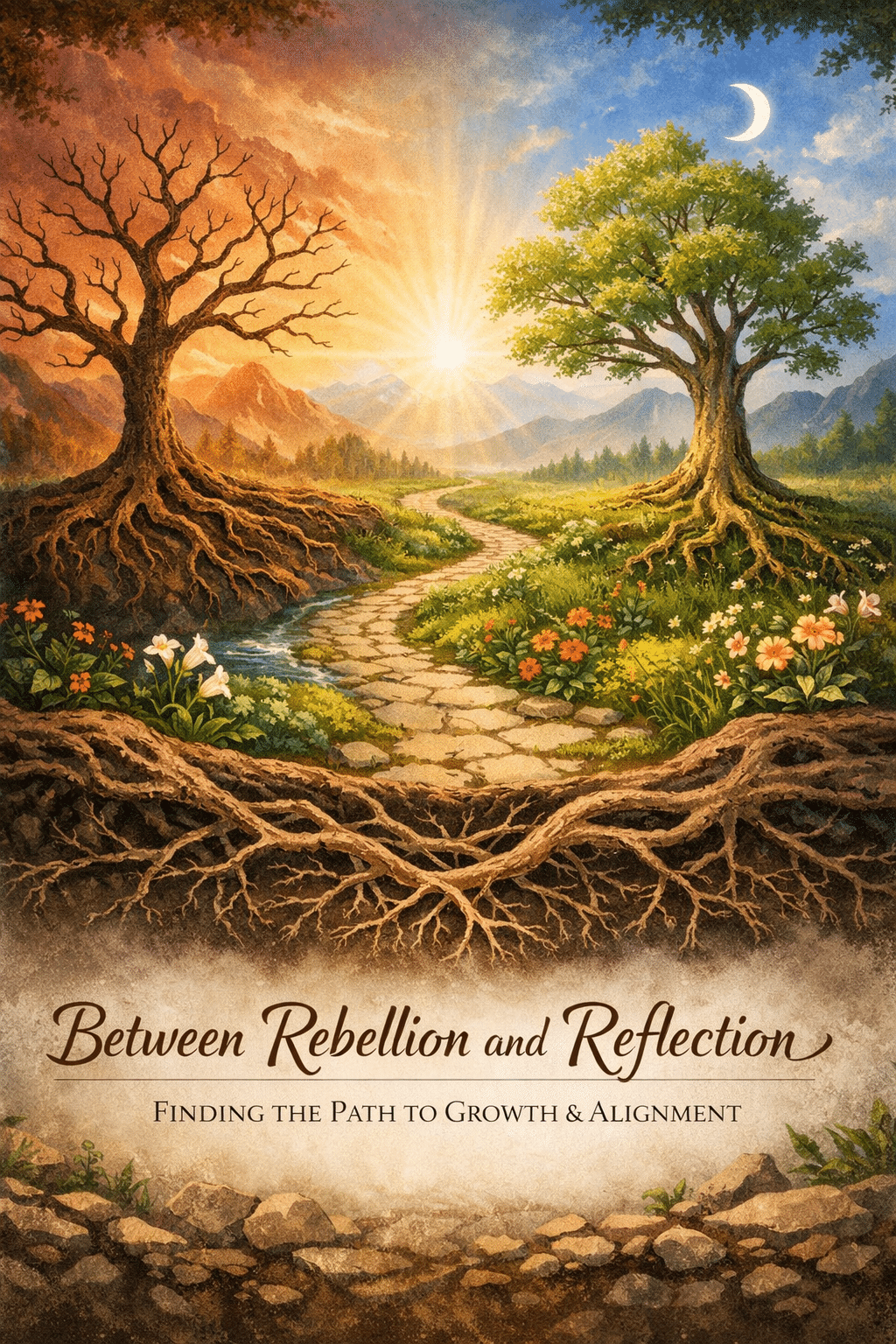
In comparing Satan and Hamlet, I was unknowingly examining two paths: one of forceful action, one of reflective restraint. But neither fully resonated as a place to live. Even then, I sensed that unchecked rebellion could lead to misalignment, while endless hesitation could prevent purpose from ever taking form. What I was searching for, though I could not yet name it, was a third way.
Today, that third way is no longer abstract. It is taking shape through my work with Arete Grows.
Arete Grows is not built from rebellion alone, nor from hesitation. It is being cultivated through alignment, through listening, discernment, and intentional action. The same questions I carried at twenty have not disappeared; they have evolved. Instead of asking whether to act or wait, I am learning to recognize when action is aligned and when pause is necessary. Instead of choosing between certainty and doubt, I am learning to move forward with trust, even when full clarity has not yet arrived.
In this way, the tension I once studied has become a practice I now live.
There are moments in building Arete Grows that require decisive movement, reaching out, creating, organizing, trusting the vision even when it stretches beyond what is immediately visible. There are also moments that require stillness, istening for guidance, allowing connections to form organically, and resisting the urge to force outcomes that are not yet ready. Both are essential. Both must coexist.
Looking back, I can see that my earlier comparison of Satan and Hamlet was not simply about literature, nor only the product of an academic assignment. It was an early attempt to understand how to hold power responsibly, how to act without losing integrity, and how to reflect without losing momentum. The classroom gave me the framework, but the question itself came from somewhere deeper.
Neither character offered a resolution. Satan’s path leads to isolation shaped by pride; Hamlet’s path leads to loss shaped by hesitation. But between them exists a space of integration, a way of being that honors awareness while still allowing movement. That is the space I am stepping into now.
The creation of Arete Grows is, in many ways, the answer to a question I began asking years ago. It is an embodiment of choosing neither extreme, but instead cultivating a path rooted in purpose, connection, and growth. It is action informed by reflection. It is movement guided by alignment.
At twenty, I did not know where that inquiry would lead. I only knew that I was drawn to the tension.
Now, I am living its resolution.
And what once existed as a comparison on a page, formed in a classroom, under guidance, within a moment of becoming, has become a way of moving through the world.